Ncantu Home
Vicolo dell’Origlione, 1 – 90134 Palermo




Vicolo dell’Origlione, 1 – 90134 Palermo
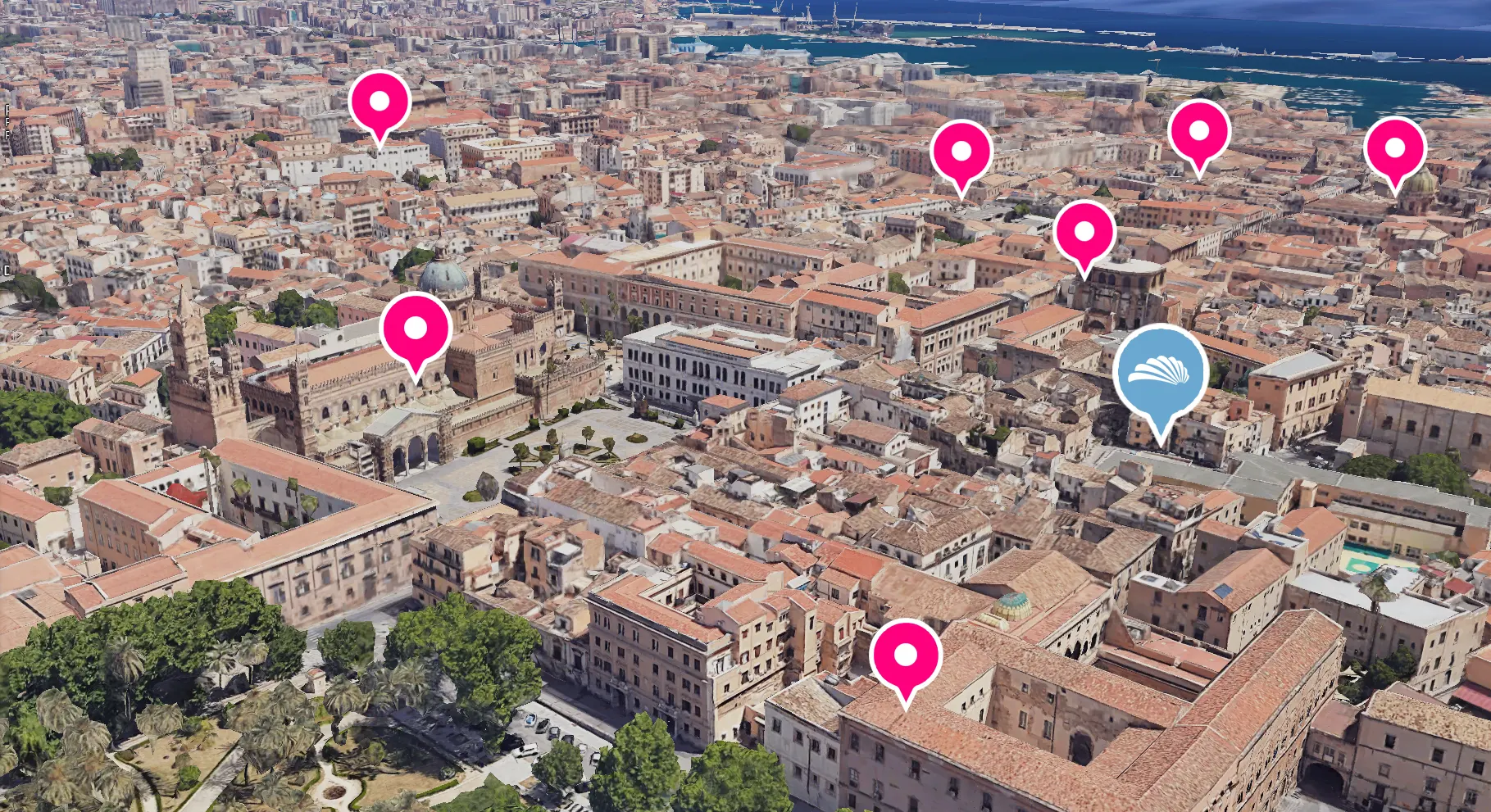
The accommodation is located near famous places of interest, such as the Church of the Gesù, Via Maqueda and the Vucciria.
Cathedral
It is considered the “history book of Palermo,” as all the successive rulers over the centuries have left traces of their passage; its construction dates back to 1184.
Palazzo delle Aquile (or Praetorium)
The most representative civil building in the city, as the seat of the Municipality of Palermo, was built in 1470 by architect Giacomo Bonfante at the behest of Praetor Pietro Speciale. Over the centuries, it underwent countless transformations, among the most notable being the one in 1553 when the main entrance was moved from Piazza Bellini to Piazza Pretoria, and the one between 1874 and 1891 by architect Giuseppe Damiani Almeyda, who gave the palace its current form.
Royal Palace or Norman Palace
Built around the 10th century by the Arab emirs. The Norman kings, who chose it as their residence, conceived it as a fortress, but also as a dwelling of exceptional sumptuousness and refinement.
Porta Nuova
One of the most representative examples of triumphal architecture in Palermo, it represents the western entrance to the city. It was built to commemorate the solemn entry into Palermo of Emperor Charles V in 1535, returning from a victorious military campaign in Africa. Construction, however, began only in 1569 and was completed under the viceroyalty of Marcantonio Colonna; for its construction, the modest existing 15th-century gate was demolished.
Porta Felice
Dedicated to the wife, Donna Felice Orsini, of Viceroy Marcantonio Colonna, its construction began in 1582, but work was interrupted shortly thereafter. It was resumed in 1602 under the direction of Mariano Smiriglio and completed in 1637 by Vincenzo Tedeschi.